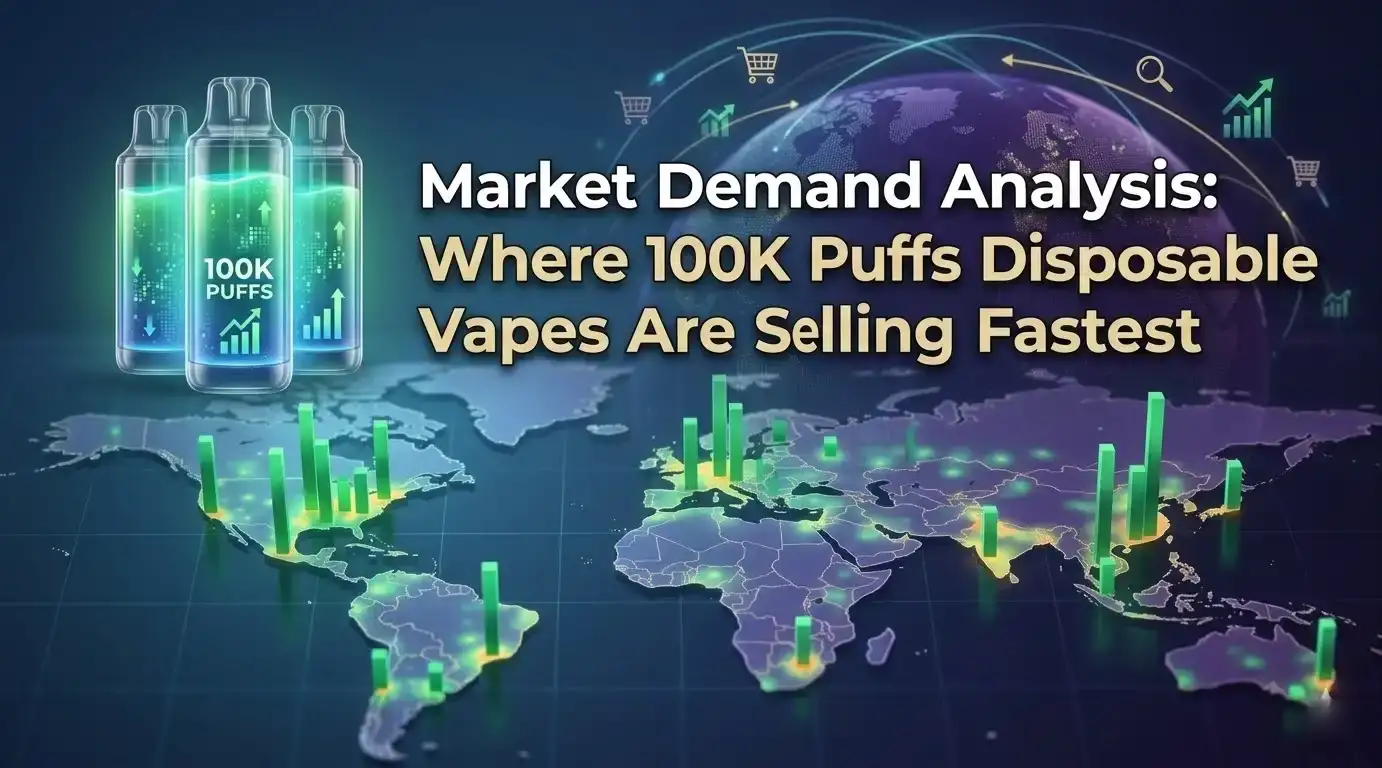
If you're stocking 100K puff disposables right now, the question isn't really "where is demand growing." It's "which markets will still let you sell these in twelve months." That's the honest starting point for 2026, and it's a different conversation than the one most market reports are having.
The global disposable vape category is worth somewhere around $9.6 billion this year, according to estimates from Research Nester and a few other market research firms tracking the space. North America accounted for roughly half of that revenue in 2025. Those numbers look healthy on paper. What they don't show is that three of the largest developed markets outside the US have already banned the exact product format you're selling, or are about to.
The US remains the largest single market for disposable vapes, and it's also the most fragmented from a compliance standpoint. As of May 2026, the FDA has granted full marketing authorization to only 45 e-cigarette products, all from five companies, and none are the high-puff disposables that dominate convenience store shelves. That means most of what's currently sold in the US is technically unauthorized, even though enforcement against individual retailers varies a lot by state.
States have split into three rough categories. Some, like California, Massachusetts, and New York, ban flavored disposables outright. Others run a "product directory" system where only FDA-authorized items can legally be sold, which in practice removes almost everything except a handful of tobacco and menthol products. A third group has minimal state-specific rules beyond the federal baseline. Texas took a different approach entirely with SB 2024, which restricts disposables manufactured in China and other flagged countries rather than targeting flavors.
The federal government also changed how it handles imports this year. The FY2026 agriculture appropriations bill lets customs seize and destroy unauthorized vape shipments at the border instead of holding them for review, aimed squarely at Chinese-manufactured disposables that haven't gone through PMTA. If you're importing into the US, this is the single most important operational change to plan around, more than any state law.
For wholesalers who want to stay in this market, the practical move is to focus on documentation. Buyers increasingly ask for lab testing records, PMTA status, and country-of-origin paperwork before they'll place an order, not after.
China still makes more than 90 percent of the world's vaping hardware, with Shenzhen as the manufacturing center. China's domestic retail market is tightly restricted, so it exports most of what it produces. The most recent full-year export figures put China's total vape exports at roughly $11 billion, with the US alone accounting for close to 28 percent of that volume. This concentration is worth keeping in mind. A production slowdown or a new export restriction out of Shenzhen affects the entire global supply chain at once, which is exactly why VegVape works with more than one factory relationship rather than a single source.
Japan gets mentioned a lot in vape market reports as a growth market, and the framing is misleading. Nicotine-containing e-cigarettes cannot legally be sold at retail in Japan unless they go through pharmaceutical approval, which almost none have. The legal nicotine alternative that dominates the country is heat-not-burn tobacco, products like IQOS, not vapes. Demand for nicotine disposables in Japan largely moves through cross-border and gray-market channels instead of regulated retail. One industry tracker recorded a sharp jump in China's e-vapor exports to Japan earlier this year, which shows demand exists, but it doesn't show a legal retail channel to sell into. Treat Japan as a market to watch for regulatory change, not a market to build a sales strategy around today.
This is where most 2026 market reports get it wrong, including the version of this article that ran here previously. Belgium banned the sale of disposable vapes starting January 2025. France followed in February 2025. The UK banned them in June 2025, and UK vape sales dropped over 20 percent by unit volume within months of the ban taking effect. These aren't flavor restrictions or nicotine caps. They're outright bans on the single-use format itself. Rechargeable and refillable devices remain legal in all three countries.
A bigger structural change is also coming. The EU Battery Regulation will prohibit devices with non-replaceable, non-removable batteries across all 27 member states starting in February 2027. Most 100K puff disposables use exactly that kind of battery. Once that rule takes effect, the current disposable format becomes illegal to sell anywhere in the EU, not just in the countries that have already banned it individually. Separately, the EU's Tobacco Products Directive revision (TPD III) has been pushed to a mid-2026 proposal with implementation likely landing in 2028 or 2029, and it may add further flavor restrictions on top of the battery rule.
If Europe is part of your distribution plan, the honest read is that the window for single-use 100K puff units is closing on a fixed timeline, not shrinking gradually. Our vape mods and kits category covers the rechargeable formats that will still be legal after 2027, which is worth having ready for European buyers now rather than later.
Malaysia's health minister has stated a nationwide vaping ban is coming, though as of mid-2026 it still hasn't been legislated. In the meantime, existing rules under Act 852 already cap nicotine at 20mg/mL and will limit disposable pod capacity to 2mL starting October 2026, well below what a 100K puff device typically holds. Several Malaysian states have stopped issuing vape licenses entirely.
The Philippines is a different case. Disposable vapes remain legal and reasonably well regulated under RA 11900, with nicotine limits up to 65mg/mL. But in January 2026, the Department of Trade and Industry proposed banning open-system devices and refillable e-liquids specifically, showing regulators are willing to ban by product category rather than by flavor or nicotine level. Authorities have also reported a rise in illegal vape seizures this year, mostly smuggled flavored products.
Neither market is closed. Both are worth checking against current rules before committing inventory, since the regulatory model in this region seems to shift every few months.
Mexico banned the importation, sale, and distribution of all vaping products through a decree published in the Diario Oficial de la Federación, which took effect January 16, 2026. That's a full market closure, not a growth story, and it's worth flagging because older market reports (including outdated versions of this page) still describe Latin America as an emerging opportunity. Check Mexico off the list. Other countries in the region haven't followed with bans of the same scope, but the direction of travel across multiple regions this year has been toward restriction rather than openness.
The throughline across every region here isn't consumer demand. Demand for high-capacity disposables is strong almost everywhere. The constraint is regulatory, and it's moving faster than most sourcing calendars account for. A few things follow from that:
Order in shorter cycles. Three to four months of stock gives you room to adjust before a rule change leaves you holding inventory you can't sell.
Keep documentation ready before a buyer asks for it, not after. Testing records, PMTA status where applicable, and country-of-origin paperwork are becoming standard requests, not extras.
Have a rechargeable alternative on hand for markets where the disposable format itself is the problem, not the flavor or nicotine level. Europe post-2027 is the clearest example, but it won't be the last one.
If you're sourcing 100K puff units for a specific market and want current compliance status before you place an order, our team can walk through it on a call. It's a shorter conversation than finding out after the shipment lands.
Are 100K puff disposable vapes still legal to sell in the EU?
It depends on the country and the timeline. Belgium, France, and the UK have already banned single-use disposables outright, so the answer there is no, regardless of puff count. In the rest of the EU, they're still legal for now, but the EU Battery Regulation will ban devices with non-replaceable batteries bloc-wide starting February 2027, which covers most current 100K puff designs. Rechargeable and refillable formats aren't affected by either rule.
Why are the UK, France, and Belgium banning disposables specifically, instead of just restricting flavors?
The stated reasons are environmental waste and underage appeal, not nicotine content or flavor. That's an important distinction, because it means reformulating a product (tobacco-only flavor, lower nicotine) doesn't get around the ban. The format itself, single-use with a built-in battery, is what's prohibited.
Can I still export 100K puff disposables to Japan?
Not through a legal retail channel. Nicotine e-cigarettes require pharmaceutical approval to be sold in Japan, and almost none have it, so there's no regulated storefront market to sell into. Demand exists and moves through cross-border and gray channels, but that's a different (and riskier) proposition than a normal wholesale relationship.
What documentation do US buyers expect before placing a wholesale order in 2026?
Increasingly, buyers request lab testing results, PMTA status, and country-of-origin paperwork up front rather than after a shipment is flagged. This has become more common since the FY2026 border seizure rule took effect, as retailers don't want unauthorized imports getting destroyed in transit.
Is Latin America still an open market for disposable vapes?
Mexico is not. It banned the import, sale, and distribution of all vaping products starting January 17, 2026. Other countries in the region haven't followed with bans of the same scope, but it's worth checking country by country rather than treating the region as a single open market.
Will Malaysia's proposed vaping ban affect orders placed now?
As of mid-2026, the ban hasn't been legislated, so current orders aren't directly affected. But existing rules under Act 852 already cap disposable pod capacity at 2mL starting October 2026, which is far below a typical 100K-puff device's e-liquid volume, so that change is worth planning around regardless of whether the full ban happens.
The disposable vapes...
READ FULLIf you're stocking 100K puff disposables right now, the question isn't really "where is demand gr...
READ FULLThe global vape market has been growing rapidly over the last 10 years. Vaping produc...
READ FULL