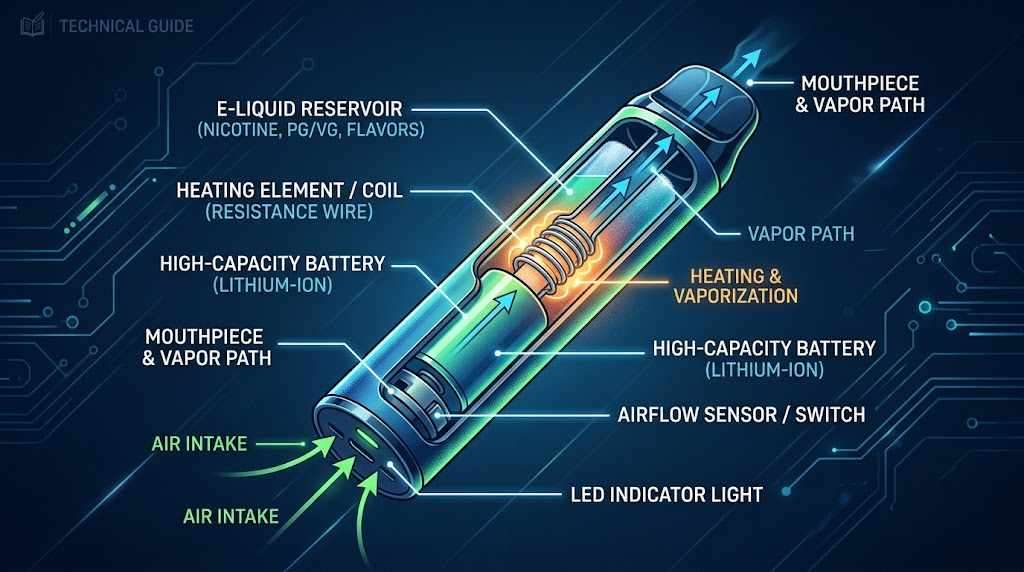
Disposable vapes represent one of the fastest-growing segments in the vaping market, projected to reach $8.5 billion by 2030. Yet many users have little understanding of how these devices actually function. This guide breaks down the engineering behind disposable vapes, from battery chemistry to vapor production.
Important Note: Vaping products contain nicotine, which is highly addictive. This content is educational and does not constitute medical advice.
A disposable vape is a single-use electronic nicotine delivery system (ENDS) containing a pre-filled e-liquid tank and non-rechargeable battery. When the battery depletes or liquid runs out, you discard the entire device.
Key characteristics:
Unlike rechargeable pod systems, disposables can't be refilled or recharged in most models.
Nearly all disposable vapes use lithium-ion polymer (LiPo) cells, the same chemistry in smartphones and laptops.
Specifications:
Why non-rechargeable? Non-rechargeable batteries simplify manufacturing, reduce cost, eliminate repeated charge cycles (which degrade batteries), and avoid certain regulatory classifications.
The battery gradually loses voltage as it discharges, from 4.2V down to 3.0V (cutoff). This voltage drop directly affects vapor production, which is why you notice reduced vapor near the end of device life.
The coil is where liquid transforms into vapor through rapid heating.
Construction:
How it works: Electrical current flows through the wire's resistance, generating heat according to Ohm's Law (Power = V²/R). A typical disposable operates at 7-15 watts, heating the coil to 300-400°F (150-200°C), hot enough to vaporize e-liquid but cool enough to prevent burning the surrounding cotton.
The cotton acts as both a liquid reservoir and thermal bridge, wicking e-liquid toward the coil while preventing destructive temperatures.
The sealed tank holds flavored liquid until vaporization.
Tank specs:
Tank capacity directly correlates with puff count. A 2mL tank yields roughly 2,000-2,500 puffs (depending on puff duration).
Between the coil and mouthpiece is a small chamber where vapor briefly collects, allowing it to cool from 300-400°F to approximately 150-180°F before inhalation. This cooling makes the vapor more comfortable to inhale.
The mouthpiece (typically silicone or plastic, 5-8mm diameter) affects draw feel but not vapor production.
When you inhale, a piezoelectric or capacitive sensor detects the pressure change. This triggers the control circuit to send power to the heating coil within milliseconds. No button means no user error, the device activates exactly when you want to vape.
Electricity flows through the wire's resistance, heating it to 300-400°F within 50-200 milliseconds. At this temperature, the coil efficiently vaporizes e-liquid without burning it.
Heat causes e-liquid's components to transition from liquid to vapor (gas):
Freshly created vapor enters the atomization chamber, cooling and homogenizing before you inhale.
Cooled vapor travels through the mouthpiece into your lungs. Nicotine is absorbed rapidly, reaching peak plasma concentration in 5-10 minutes (faster than smoking, which takes 20-30 minutes). Flavorings accompany the nicotine, detected by taste and olfactory receptors.
Once you stop inhaling, the sensor stops detecting airflow. Power cuts within milliseconds, and the coil cools within 1-2 seconds.
E-liquid is typically a 50/50 to 70/30 blend of:
Propylene Glycol (PG): A thin, odorless liquid that:
Vegetable Glycerin (VG): A thicker, slightly sweet liquid that:
Most disposables use balanced 50/50 or 60/40 VG/PG ratios to optimize vapor production, wicking, and throat hit.
Flavorings: Food-grade compounds (5-15% of e-liquid). Common concerns include:
Nicotine types:
According to the American Psychiatric Association, nicotine is highly addictive, binding to acetylcholine receptors and triggering dopamine release, the "reward" neurotransmitter.
Manufacturers test puff count by automated machines using standardized 2-3 second puffs, 30 seconds apart.
Standard puff counts:
Real-world expectations: Most users get 70-90% of advertised puff count because:
A disposable becomes unusable when either the battery dies or the liquid runs out, whichever occurs first.
Lithium-ion batteries degrade with each use cycle and naturally over time (~3% per year at room temperature). Liquid consumption depends on coil wattage and puff duration, typically 1-2mg per puff.
Quality manufacturers balance these so battery and liquid lifespan are roughly equal.
Most obvious sign. Battery voltage may be too low to reach vaporization temperature, or e-liquid is depleted.
Cotton burns when insufficient e-liquid reaches the coil (dry burn), producing acrid flavor and throat irritation. This results from liquid depletion, chain vaping overwhelming the wick, or coil degradation from residue buildup.
As devices age, residue from flavorings accumulates on the coil. Lower battery voltage also reduces heating efficiency. Your taste buds may also experience fatigue.
Battery completely dead, sensor malfunction (rare), or internal connection failure (rare).
Usually from temperature extremes (heat expands liquid; cold causes condensation) or improper storage (upside down). Leakage means the device won't reach advertised puff count.
Disposable vapes contain hazardous materials and cannot go in regular trash:
Proper disposal:
Modern e-waste recycling recovers 80-95% of lithium-ion materials, which are used in new batteries and circuit boards.
Rechargeable disposables (2023-present) can be recharged via USB-C but aren't refillable, a middle ground between full disposables and pod systems. They reduce e-waste by 30-50% compared to non-rechargeable versions.
Mesh coils (emerging): Increased surface area improves heat distribution and flavor delivery compared to standard coils.
Advanced sensors (higher-end models): Can detect puff duration and adjust power output, or monitor coil temperature to prevent burns.
Nicotine addiction: Regular vaping leads to dependence, particularly with high-salt products (20-50mg/mL). Cessation involves withdrawal symptoms.
Respiratory effects: Research suggests:
Youth concerns: Disposables are particularly problematic for adolescents due to portability, appealing flavors, high nicotine, and potential impact on developing brains (development continues into mid-20s).
Studies continue examining:
| Factor | Disposables | Pod Systems |
|---|---|---|
| Upfront cost | $5-15 | $25-50 |
| Cost per puff | Higher | Lower |
| E-waste | High | Lower (reusable device) |
| Convenience | Maximum | Good |
| Lifespan | 300-5,000 puffs | Years per device |
Choose disposables for: Occasional use, travel, trying vaping Choose pods for: Daily use, cost-consciousness, environmental concerns
Mods are larger, powerful devices with rechargeable batteries, refillable tanks, and customizable settings.
| Factor | Disposables | Mods |
|---|---|---|
| Learning curve | None | Steep |
| Upfront cost | Low | High ($50-150+) |
| Ongoing cost | High | Very low |
| Vapor production | Moderate | Very high |
| Customization | None | Extensive |
Choose mods for: Daily heavy use, hobbyists, cost-efficiency
How do I know when a disposable vape is empty? Consistent lack of vapor, burnt taste, or no sensor response when you inhale. Expect 70-90% of advertised puff count.
Can disposable vapes leak? Yes, from temperature extremes (heat expands liquid; cold causes condensation), upside-down storage, or physical impact. Proper storage (room temperature, upright, in protective case) minimizes leakage.
Can you refill a disposable vape? Technically yes, but it's not recommended. Refilling risks damaging internal components, may damage seals, often causes reliability issues, and voids warranties. Pod systems or mods are better alternatives.
Are rechargeable disposables better? They extend device lifespan 30-50%, reducing e-waste if you would have bought multiple non-rechargeable units. Still can't be refilled; still create waste eventually.
Can you take disposable vapes on a plane? Carry-on: Yes, in most cases (declare them). Checked baggage: No, lithium-ion batteries are prohibited due to fire risk. Always confirm your airline's current policy before traveling.
Disclaimer: This article is educational and does not constitute medical, legal, or product safety advice. Vaping products contain nicotine, which is addictive. Consult a healthcare professional for health concerns. Always follow local regulations.
The disposable vapes...
READ FULLIf you're stocking 100K puff disposables right now, the question isn't really "where is demand gr...
READ FULLThe global vape market has been growing rapidly over the last 10 years. Vaping produc...
READ FULL